We believe the future of work depends on leaders who are willing to challenge the systems that exhaust people and call it performance.

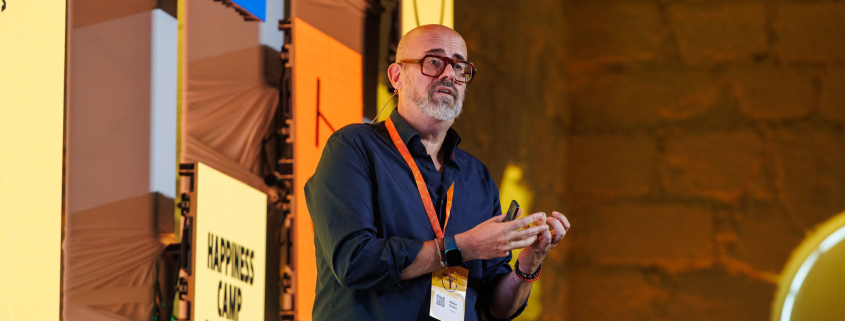
Today, we welcome a voice that has been doing exactly that for years. Jen Fisher, Director of Impact and Community at Happiness Camp , joins Happiness Camp 2026 as part of our Executive Council and invited specialists.

Jen brings a perspective shaped by lived experience, deep listening and a clear conviction. Burnout is not a personal failure. It is a design flaw. And work culture will only change when we stop asking people to adapt to broken systems and start redesigning those systems with humanity at the centre.

At the heart of her work is a simple but powerful idea. Work should leave people better, not emptier. More human, not more depleted.

As she shared with us:

“I’m done playing nice with work cultures that treat humans like renewable resources.”

This perspective is not theoretical. It is grounded in years of working inside organisations, leading wellbeing at scale, and naming what many people feel but struggle to articulate.

Who is Jen?
Jen leads Impact & Community at Happiness Camp and is globally recognised for her work at the intersection of wellbeing, culture and organisational responsibility. Her career has been shaped by a deep commitment to changing how organisations think about performance, burnout and human sustainability.

Her approach is grounded in honesty, empathy and systemic thinking. And in challenging one of the most persistent myths of modern work culture: that pressure is the price of performance.

In her conversation with us, Jen shared reflections that feel both confronting and deeply human:

  • The work culture belief she would cancel forever: the idea that people must be pushed to the edge to perform
  • The wellbeing ritual that keeps her grounded: exercise, sleep and surrounding herself with people who meet possibility with “heck yes”
  • The moments she feels most human in her work: when someone pauses and asks, “wait, are we allowed to talk about this?”

These moments may sound simple. But they point to something essential. Real change begins when honesty becomes possible. And when systems are designed to support people, not extract from them.

What to expect at HC 2026?
Jen joins a global group of leaders who are redefining how organisations think about wellbeing, leadership and human sustainability. Together, they are shaping conversations about the future of work that are bold, uncomfortable and necessary.

More global voices will join the Executive Council soon, and we will be sharing them in the months ahead.

For now, one thing is clear.

Happiness Camp 2026 just became more honest, more courageous and more human.

A reminder that resilience without empathy is just survival.
And one the future of work can no longer afford to ignore.

Welcome, Jen.
The Reset is in motion.
And you are an essential part of it.

Rethinking Human Sustainability in Modern Work Cultures
For decades, conversations about work have focused primarily on performance, productivity and resilience . Organisations have invested heavily in systems designed to help people endure pressure, adapt faster and recover quickly, often without questioning whether the environments themselves are sustainable.

At Happiness Camp, we believe the question needs to shift.

Not only how people perform, but how work leaves them.

This distinction sits at the heart of human sustainability . Work will always require effort, focus and energy. But when work consistently leaves people depleted, disengaged or disconnected , the issue is rarely individual resilience.

From Individual Endurance to Human Sustainability
Traditional models of resilience have framed strength as endurance. The ability to push through pressure, absorb stress and continue delivering regardless of circumstances. While this mindset has helped organisations navigate moments of disruption, it has also normalised exhaustion as a marker of commitment.

Human sustainability calls for a broader view.

It recognises that sustainable performance is not built on constant recovery, but on environments that respect human limits, rhythms and needs. It shifts responsibility away from individuals having to cope, and towards organisations designing work in ways that support long-term wellbeing, engagement and contribution .

This is not a soft or abstract idea. It is a strategic one .

The Link Between Wellbeing and Performance
A growing body of research shows that wellbeing and performance are not competing priorities, but mutually reinforcing ones . Over the past decade, research from institutions such as the University of Oxford’s Wellbeing Research Centre has helped establish clear links between employee wellbeing, including satisfaction, purpose and manageable stress levels, and organisational outcomes such as productivity, engagement and retention.

Organisations that pay attention to how people experience work tend to see stronger collaboration, greater adaptability and more consistent performance over time. When people feel supported, seen and able to bring their full selves to work , they are better equipped to contribute sustainably.

Human sustainability is not about lowering ambition. It is about redefining what sustainable ambition looks like.

Culture Is the System People Live Inside
Work does not exhaust people in isolation. Cultures do.

The way meetings are run, how success is measured, how pressure is communicated, how mistakes are treated and how much psychological safety exists in everyday interactions all form the system people operate within. When that system rewards constant urgency, over-availability and silence in the face of overload, individuals adapt by disengaging, disconnecting or burning out.

This is something we see consistently in conversations with leaders, organisations and communities connected through Happiness Camp. Across industries, roles and geographies, the pattern repeats. When culture ignores human limits , performance eventually follows.

Human sustainability requires leaders to examine not only behaviours, but the systems that shape them.

What Does It Mean for Work to Leave People Fuller?
When work leaves people fuller, it does not mean work is easy or comfortable. It means work is meaningful, coherent and aligned with human capacity.

People leave the day challenged but not depleted, engaged but not eroded, tired yet still connected to purpose. In these environments, learning happens naturally, collaboration improves and creativity increases. People are more likely to stay, grow and contribute with intention.

This is not achieved through perks or isolated wellbeing initiatives. It is achieved through thoughtful leadership, clear priorities and cultures that recognise people as living systems, not resources to be consumed.

A Responsibility, Not a Benefit
Human sustainability reframes wellbeing from something organisations offer to something they own.

It places responsibility on leaders to ask difficult but necessary questions. How does our culture feel to live in? What behaviours do we reward, explicitly and implicitly? What does success cost our people?

These questions are not comfortable. But answering them honestly is where meaningful change begins.

Looking Ahead
As work continues to evolve, the organisations that thrive will not be those that demand more resilience from their people, but those that design work in ways that sustain human energy, creativity and connection over time.

At Happiness Camp, we see human sustainability not as a trend, but as a necessary evolution. A shift from extracting performance to cultivating environments where people and organisations can grow together.

Because work should not be something people need to recover from.

It should be something that leaves them fuller.

We believe the future of work depends on leaders who are willing to slow down, question performance-driven habits and put people back at the centre of how organisations are built.

Today, we highlight a voice that has been shaping that belief from the very beginning. António Pedro Pinto, Founder & CEO of Happiness Camp , is part of the Happiness Camp 2026 Executive Council and invited specialists.

António has been building a vision that sits at the heart of the movement we are creating. One where work is not something people need to recover from, culture is not treated as a perk, and leadership carries a real responsibility for how people feel, live and grow.

At the core of his work is a clear conviction. Work should fit into life, not consume it. And organisations should leave people better, not empty.

As he shared with us:

“I’m interested in building organizations people don’t need to recover from.”

This perspective is not aspirational or abstract. It is deeply practical, grounded in lived experience and reflected in every space, conversation and community António has helped create through Happiness Camp.

Who is António?
António is the Founder & CEO of Happiness Camp, one of Europe’s largest movements focused on human sustainability, workplace culture and wellbeing. His work sits at the intersection of leadership, culture and human experience, challenging organisations to rethink how work fits into people’s lives.

His approach is grounded in presence, responsibility and real connection. And in questioning one of the most damaging assumptions of modern work culture: that pressure equals purpose.

In his conversation with us, António shared reflections that feel both honest and necessary:

•⁠ ⁠The part of work culture he would cancel forever: any culture that mistakes pressure for purpose
•⁠ ⁠The wellbeing ritual that keeps him grounded: going to the gym with his people, turning movement into connection and mental therapy
•⁠ ⁠The moments he feels most human at work: when conversations shift from performance to presence and real connection

These moments may sound simple. But they reveal something essential. Humanity at work is built in everyday choices, not grand statements.

What to expect at HC 2026?
António joins a global group of leaders who are rethinking how organisations approach culture, leadership and human sustainability. Together, they are shaping conversations about the future of work that are courageous, honest and deeply human.

More global voices will join the Executive Council soon, and we will be sharing them in the coming months.

For now, one thing is clear.

Happiness Camp 2026 continues to grow as a space where work slows down, people reconnect and better questions take centre stage.

A reminder that culture is not a perk.
It is a strategic responsibility.

Thank you for building Happiness Camp, António.
The Reset is in motion.

Wellbeing and Resilience in Porto

Last year, I had the privilege of speaking to 3000 people at Happiness Camp in Porto about wellbeing in the workplace . I shared insights on how organisations can balance stress, satisfaction, happiness, and purpose , the four key indicators of sustainable human performance . The week was memorable in many ways, including disruption caused by a nearby forest fire, which meant attendees had to show resilience in the face of unexpected challenges , a reminder that no matter how well we plan, unpredictability is inevitable.

Why Resilience Alone Isn’t Enough

For most of my career, resilience was framed as the ability to endure pressure, adapt quickly, and keep performing no matter what. That perspective served me in some ways, but recent experiences, including a cancer diagnosis, a knee injury, and redundancy, taught me that endurance alone is not enough. True resilience must be paired with empathy for yourself, others, and the systems in which you work. I call this empathetic resilience.

That experience, along with surgery on my knee (deep holes drilled into my exposed bone), and ultimately being made redundant, reshaped how I think about strength. These moments didn’t change what I value, they reinforced it. They gave me clarity on the importance of designing workplaces that are human-centric and sustainable, which I continue to focus on in my consulting and presentations.

Empathetic resilience is about recognising limits and designing environments that support sustainable performance . It is not a soft skill or temporary fix, but a shift in mindset that values human experience as much as output. Organisations that embrace it understand that employees thrive when they feel seen, supported, and able to engage fully with their work.

Wellbeing Drives Performance

Evidence supports this. Research from the University of Oxford’s Wellbeing Research Centre shows that higher levels of employee wellbeing , including satisfaction, purpose, and stress management , are positively associated with organisational performance. Companies with higher wellbeing see employees achieve goals more consistently and adapt more effectively to change. At my previous employer LinkedIn, for example, internal data has consistently shown that teams with higher engagement and wellbeing scores outperform peers in both delivery and retention. This demonstrates that human sustainability is not only ethical, it is strategic. 

Empathy in Action

Putting these ideas into practice can be highly tangible. I ran a workshop with a large retail company’s entire TA function, where we explored candidate experiences through empathy exercises. Teams put themselves in the shoes of candidates from different, less-represented demographics, identifying barriers and considering ways to remove them. The exercise shifted perspectives and highlighted the importance of designing processes that are inclusive, thoughtful, and human-centric . This is exactly the kind of applied empathetic resilience that turns theory into meaningful change.

Key Insights for Leaders

Create systems that support human sustainability. Challenge cultures that reward endurance at the expense of wellbeing and design workflows that enable reflection, recovery, and growth.

Invest in skills-based thinking and emotional intelligence. AI and technology will continue to reshape roles rapidly, but the human ability to understand, empathise, and adapt remains irreplaceable.

– Measure success beyond outputs. Track how your people experience work. Satisfaction, belonging, and purpose are as important as performance metrics.

The Future of Human Sustainability

The evolution of resilience calls for a broader view of what it means to be strong. Endurance is not enough. Empathy, insight, and systemic support are what sustain individuals and organisations through uncertainty. When organisations integrate human sustainability into their operations, they not only protect employees’ wellbeing but also improve business outcomes.

Across Europe, the conversation is shifting. Organisations are beginning to understand that thriving employees drive thriving businesses. Discussing these ideas with leaders from across the continent highlighted a shared desire to build workplaces where people feel supported, empowered, and capable of achieving their best . Being given the all-clear and now cancer free reminded me that true resilience only works when it is paired with empathy, for yourself, for others, and for the systems in which you work. Empathetic resilience is the bridge between human experience and organisational success , enabling us to bounce forward rather than bounce back in the face of uncertainty, and creating workplaces where people and businesses flourish together. 

by Danny Stacy, Head of Talent Intelligence @ Indeed UK

A thoughtful woman sitting at her desk, looking concerned and reflective, symbolising the impact of toxic positivity in the workplace.

In many workplaces, phrases like “good vibes only” or “keep it positive” are used as rallying cries to maintain morale. As a manager or HR professional, you might be encouraging positivity with the best intentions. After all, who doesn’t want a happy, upbeat team? But forcing an always positive attitude can backfire. In fact, this kind of toxic positivity, the practice of shutting down any “negative” emotions or feedback, often ends up stifling honesty and harming employees’ well-being. Under a relentless “good vibes only” rule, people start to feel they can’t speak up about real issues, and that can leave your team feeling frustrated, unheard, and yes, miserable.

What Is Toxic Positivity?

Toxic positivity refers to an excessive, insincere optimism that dismisses or invalidates any negative feelings. It has been described as “the unchecked insistence on good vibes at all costs.” Essentially, it’s pressure to smile through exhaustion, to reframe every setback as a growth opportunity, to stay upbeat no matter what. While staying optimistic has its benefits, there’s a fine line between looking on the bright side (which is healthy) and repressing the dark side (which is toxic). Toxic positivity crosses that line by treating any stress, concern, or criticism as something to be avoided or “fixed” with a platitude. It’s not the same as genuine optimism or resilience. Instead, it denies the reality of painful events and negative emotions in favor of pretending everything is okay.

Psychologists note that toxic positivity is basically emotional suppression dressed up as encouragement. You might hear it in well-meaning phrases like “It could be worse,” “Don’t be so negative,” “Just look on the bright side,” or the classic “good vibes only.” These remarks usually come from a desire to help or keep the peace. However, by ignoring or brushing aside painful feelings, toxic positivity actually thwarts people’s ability to process challenges and deal with them in a healthy way.

Key point: Positivity itself isn’t the enemy. Forced positivity at the expense of truth is. A truly healthy workplace encourages optimism alongside honesty, not at its expense.

Why “Good Vibes Only” Culture Backfires

Insisting on perpetual positivity might create a superficial calm in the short term, but beneath the surface it often breeds silence, stress, and disengagement. Here’s why a “good vibes only” culture can make your team miserable:

  • It Silences Honest Communication: When positivity becomes the only acceptable emotion in the office, employees quickly learn to hold back anything that isn’t upbeat. The unspoken message is “Keep it light. Don’t bring the heavy stuff here.” So people oblige. They withhold their real feelings, concerns, and feedback. Over time, that silence erodes trust and team cohesion. Problems fester instead of being addressed. As one leadership coach put it, “people can’t genuinely move forward until they’re allowed to sit with what’s hard.” A good-vibes-only rule takes away that permission.

  • Psychological Safety Vanishes: A workplace steeped in toxic positivity often lacks psychological safety, the feeling that you can speak up or fail without fear. If employees don’t feel seen or heard when something’s wrong, they’ll stop sharing bad news or new ideas altogether. Research backs this up. A recent study found that teams led by managers who dismissed negative emotions were significantly less likely to raise concerns about failing projects. In other words, when people feel pressure to “stay upbeat,” they stay quiet instead. Small issues stay hidden and snowball into big ones, hurting both morale and the bottom line. Without an environment where all feelings (even uncomfortable ones) can be voiced, performance doesn’t soar, it stalls.

  • Trust and Engagement Erode: Ironically, forcing constant positivity can make employees lose trust in leadership. When every challenge is met with a sunny platitude, people eventually stop believing the message and the messenger. Studies show that employees subjected to excessive “cheerfulness” during times of change reported significantly lower trust and engagement at work. They perceived the relentless optimism as inauthentic. Co-workers might start wondering, “Do our leaders actually care or understand what’s going wrong?” If the answer seems to be “no,” engagement plummets.

  • Emotional Pressure Leads to Burnout: For individual team members, toxic positivity can be emotionally exhausting. Bottling up stress and frustration behind a forced smile takes a toll. Team members may appear to “handle it” on the outside while quietly burning out on the inside. Experts warn that when we “push aside normal emotions to embrace false positivity, we lose capacity to deal with the world as it is.” In other words, denying legitimate feelings doesn’t make them go away. It makes us less resilient. Over time, suppressed emotions have a way of surfacing as fatigue, anxiety, or disengagement. Studies even link habitual emotion suppression to worse health outcomes. People who regularly hide their negative feelings tend to experience more stress, more negativity, and even a weakened immune response. Far from making the team “tougher,” a good-vibes-only policy can leave everyone drained and demoralized.

  • Authenticity and Innovation Suffer: A “positive vibes at all times” culture doesn’t just mask problems. It can also smother innovation and growth. When employees don’t feel safe to say “This isn’t working,” mistakes and bad ideas persist longer than they should. Team members become risk-averse and stick to the status quo, because raising a controversial point might be labeled as “negative.” By contrast, the most innovative teams thrive on candid feedback and a mix of perspectives. When people finally feel safe to share what’s not working (not just the good news), you unlock trust, accountability, and meaningful connection. These are the real building blocks of a strong culture. In such honest environments, problems surface sooner and innovation flourishes, not because everyone is endlessly positive, but because they feel safe enough to speak up and take necessary risks.

It’s telling that the hashtag #ToxicPositivity has gained millions of views on social media, filled with stories from employees fed up with faux positivity. In one viral example, an employee told her boss she was overwhelmed, and the response she got was a link to a mindfulness video and an instruction to “find the lesson.” The only lesson she learned? Don’t speak up again. These real-world tales underline how an atmosphere of “good vibes only” can quietly breed resentment, fear, and misery on a team.

Actionable Strategies: Fostering a Healthier, More Authentic Team Culture

Breaking the toxic positivity cycle doesn’t mean letting people gripe endlessly or abandoning optimism. It means creating a workplace where positive thinking and honest reality checks coexist. Here are some actionable strategies for managers, HR leaders, and wellness practitioners to consider:

  • Invite Real Talk (Not Just Cheerleading): Make it a habit to ask questions that give permission for honesty. For example, in team meetings, balance “What’s going well?” with “What’s weighing on us right now?” When you explicitly invite people to share challenges or concerns, you signal that it’s safe to bring up the “heavy stuff.”

  • Normalize Discomfort: Remind your team that it’s okay to not be okay sometimes. If someone voices a frustration or worry, resist the urge to immediately shut it down or “fix” it. Instead, listen and acknowledge the difficulty. By giving people space to name what’s hard, without rushing to a solution, you validate their experience. This doesn’t spread negativity. It builds trust by showing that everyone has a voice, even on tough topics.

  • Respond with Empathy, Not Platitudes: Encourage leaders to practice empathy when employees share struggles. That might mean saying “I understand this is difficult, thank you for telling me” rather than “Look on the bright side.” Training managers in basic emotional intelligence or emotional literacy can be hugely beneficial. When people feel heard and understood, they’re more likely to stay engaged and work with you on solutions. Remember, a quick “stay positive” pep talk can feel dismissive. Often what people need first is to feel heard, not “cheered up.”

  • Treat Negative Feedback as Data: Shift your mindset to see complaints or bad news as useful information rather than threats. If an employee voices a concern, thank them and dig deeper. What insight does this feedback reveal? Even uncomfortable emotions are data that leaders can learn from. Approach issues raised by the team like a detective, not a disciplinarian. By framing problems as “data points” or opportunities to improve, you remove the stigma from discussing negatives. This approach helps root out small issues before they become big failures.

  • Model Healthy Positivity: Leadership sets the tone. Managers should model what balanced, healthy positivity looks like. That means being candid about challenges (“Yes, this project has hit a snag”) while maintaining optimism about overcoming them (“And I’m confident we can find a solution together”). Healthy positivity does not exclude suffering or disturbance. Instead, it integrates it, trusting that people can find a way forward through challenges. When your team sees you stay hopeful and honest, they’ll feel permission to do the same.

  • Build Psychological Safety: Finally, make it your mission to cultivate an environment of trust. Reinforce that no one will be punished or labeled “negative” for raising a concern or admitting a mistake. Celebrate people who identify problems or ask hard questions. This is the behavior that ultimately saves projects and drives innovation. By explicitly valuing truth-telling alongside positivity, you create the psychological safety that underpins high-performing teams. Over time, your team will realize that they won’t be shot as messengers of bad news, and they’ll bring issues to light early, when you can actually address them.

Implementing these strategies can gradually shift your culture from one of forced smiles to one of authentic support and resilience. It’s not about encouraging negativity. It’s about making room for reality. When you do, you’ll find that your team becomes more positive in a genuine way. People will be more connected, trusting, and motivated when they know they can be real with each other.

Conclusion

Toxic positivity in the workplace ultimately benefits no one. It creates a veneer of harmony while undermining the very foundations of a healthy team. By putting an end to the “good vibes only” mandate, you’re not inviting pessimism. You’re inviting truth, trust, and growth. Teams that embrace a full range of emotions, the wins and the woes, end up stronger and more successful for it. When organizations stop mistaking constant good vibes for actual good culture, something powerful happens. Teams become more honest, trust goes up, problems surface sooner, and innovation flourishes. In short, allowing your team to share bad news and tough feelings doesn’t drag the vibe down. It lifts everyone up in the long run, because people feel seen, supported, and united in facing reality together.

Empathy, openness, and authenticity are the true antidotes to toxic positivity. By leading with these values, you’ll cultivate a workplace where employees can be genuinely happy, not because they’re forced to say “everything is fine,” but because they know they’re valued, heard, and helped through the hard times. And that kind of happiness, built on trust and understanding, is far more durable and productive than any slogan on a motivational poster.

Happiness Camp 2026

Happiness Camp 2026 is your reminder that it’s time to reset the way we work and to build spaces where the human experience is not hidden, but honoured.

We don’t believe in “good vibes only.” We believe in real vibes.
In rest. In reflection. In spaces where you can be both joyful and overwhelmed. But still belong there.

Because true happiness isn’t pretending everything’s fine.
It’s knowing you’re allowed to be human, especially at work.

Ready to rethink work?
Join the movement.
The Reset is coming and it starts with you.

Portugal. September 2026.

This year in Happiness Camp, Coca-Cola is looking for partners to integrate young people in the labour market!

‘BORA Jovens is Coca-Cola’s youth employability program, implemented by Fundação Ajuda em Ação in Portugal. Since its launch in 2021, the goal is to train and place young people, aged 18 to 25, who are at risk of social exclusion, into the job market. In 3 years, we’ve empowered more than 600 young people and over 200 already entered the job market.

Our mission, together with our integration partners, is through ‘BORA Jovens creating equal opportunitiesto access the job market with a particular focus on helping young people from disadvantaged backgrounds gain the employability, skills and confidence they need to succeed.

‘BORA Jovens alongside ‘BORA Mulheres, female entrepreneurship program, are part of the Coca-Cola “This is Forward” sustainability action plan and they sit at the heart of our long-term strategy and sets out the actions we are taking forward with our local communities, with the support of powerful partnerships that inspire and engage our purposes. One of our goals in the Society pillar of “This is Forward” is to support the skills development of 500,000 people facing barriers in the labour market by 2030.

Can you open doors to young people in your company and help the community? Join us @’BORA Jovens stand in Smile Hub and we’ll share a coke or contact borajovens@ajudaemacao.org

With the vision to become the leader in sustainable energy solutions, Vestas is at the forefront of the transition to a more sustainable world.

At Vestas we design, manufacture, install, and service wind turbines across the globe. We have installed +177 GW of wind turbines in 88 countries, more than any other company in the world. Our sustainable energy solutions have already prevented 2.1 billion tonnes³ of CO₂ being emitted into the atmosphere .  

With more than 30,000 employees worldwide, human sustainability is also a core value at Vestas. The company is committed to be the safest, most inclusive and socially-responsible company in the energy industry. In 2022 we were named the Most Sustainable Company in the World in the 18th annual ranking of the world’s most sustainable corporations, published by Corporate Knights. In 2023 and 2024, we repeated as the Most Sustainable Energy company in the World in the same ranking.
Our strategy includes ensuring safe and healthy working conditions for our employees, promoting diversity and inclusion, talent development and fostering local economic development. Vestas’ initiatives aim to empower people and improve their quality of life, aligning with the broader goals of sustainable development.

By prioritizing human well-being, Vestas not only contributes to the fight against climate change but also supports the creation of resilient and thriving communities.

Through innovation and responsible business practices, Vestas continues to lead the way in sustainable energy demonstrating that the path to a greener future is also a path to a more equitable and sustainable world for all.

by Vestas

B

Happiness is at the core of human existence.
Pursuing happiness considerably shapes our lives: our decisions, relationships, and even careers.

What do you need to be happy?
This is an apparently easy and simple to tackle question. Or is it?

A core aspect of happiness is the perception of control over our circumstances.
We may not have complete control over what happens to us, but we do in how we respond. So, a core feature of happiness is the skills we develop that enable us to respond adequately to life events.

Do you want to be happy?
Before you buy your next “Top 10 Tips for Happiness book”, consider investing in your PACE profile skills:
 Problem-solving: adds resourcefulness, making you feel competent and capable in managing challenges
 Adaptability: adds flexibility and resilience, resulting in greater emotional robustness
 Creativity: gives you a sense of agency and freedom over your life
 Empathy: enhances your self-knowledge and your connection to others

PACE profile skills will strengthen your resilience, purpose, and mindset, providing a strong foundation for happiness (and success). At Next Level Corporate, we do this by developing insightful and engaging training programs for teams and corporations, enhancing their development.

Remember: invest in your skills because happiness is not given; it is nurtured.
A happy ship, just like a happy life, requires a robust structure, a clear vision, and a cohesive crew to navigate the winds, waves, and currents.

Celso Costa
Founder and CEO of Next Level Corporate

In all organizations, the role of the leader is fundamental to the success of the team and the overall performance of the company. Great leaders possess unique qualities and characteristics that set them apart, allowing them to inspire and guide their teams to achieve extraordinary results. By understanding these qualities, aspiring leaders can learn to become exceptional leaders and create excellent workplaces and successful companies.

7 unique qualities and characteristics from Great leaders

  1. Empowerment and Trust
  2. Effective Communication
  3. Clear Goals and Expectations
  4. Opportunities for Growth
  5. Promoting a Positive Work Culture
  6. Encouraging Innovation and Risk-Taking
  7. Proactively Addressing Conflicts and Challenges

In conclusion, great leaders possess a unique blend of emotional intelligence, communication skills, action-oriented capabilities, and a growth mindset. Becoming a great leader is a journey that requires continuous learning and self-improvement. By understanding the characteristics and practices that distinguish good leaders, individuals can pave the way for successful leadership and make a lasting impact on their teams and organizations. So, start your journey to becoming an exceptional leader today! Listen to your people and assess where you are on your path to becoming a “Great Leader”.

Sandra Coelho
Product Specialist

The gathering of more than 6,000 people at the Alfândega do Porto for another edition of the Happiness Camp is just the prelude to observing this transformation in the world of work, which is gaining more relevance every day.

Since millions of people around the globe and across all business sectors discovered remote work, companies have been striving to maintain their appeal. It’s not just about salary or emotional compensation; the goal is to genuinely create a culture of well-being and happiness that makes people want to be part of the team. Because employees are people, and people need and deserve to be happy, these are very welcome paradigm shifts.

Sports continue to be one of the most effective active Human Resources policies created for the well-being and inclusion of teams. In this particular aspect, Urban Sports Club’s offering is unparalleled, as it allows everyone to enjoy this benefit in a way that suits them, according to their preferences, wherever it is most convenient. Whether it’s yoga near their children’s school, padel close to the office, or a gym even when traveling for work, everyone finds what they’re looking for with a single company subscription.

However, some are transforming the way companies discover this “market of happiness, and that is the mission of Happiness Camp, with which we are immensely proud to be associated.